Paper Trading vs. Real-World Trading: Why Simulated Success Doesn't Always Transfer
It's a well-known pattern in finance, backed by both psychological research and decades of trader experience: doing well in paper trading (simulated, risk-free trading) often does not predict success once real money is on the line. This gap is so common that it's practically a cliché among professional traders and behavioral economists.
Here is why this happens, along with the research and real-world context behind it.
Why Paper Trading Success Often Fails to Translate
1. There's No Emotional Pressure
The single biggest difference between paper trading and real trading is the presence of fear and greed.
- On paper: Losing $10,000 is just a number changing color on a screen. You can close your laptop and walk away with zero real consequences.
- In reality: Losing money
you've actually earned triggers a primal fight-or-flight response. That
stress response is what causes traders to panic-sell at the worst
possible moment (the bottom), cling to a losing position while hoping
it will magically recover, or abandon a sound strategy out of sheer
desperation. This is why
having a strict protocol for remote viewing, BEFORE the markets open,
knowing where the market is headed is key.
In
other words, a strategy can be mathematically sound and still fail
â€â€
not because the math was wrong, but because the person executing it
couldn't stay disciplined or completely ahere to the required protocol
once real fear entered the picture because markets are driven by fear.
By removing fear from the equasion, panic can't sabotage the results.
2. Paper Trading Assumes Perfect, Unrealistic Execution
Most paper trading platforms simulate a perfect market that doesn't exist in reality.
- Simulated fills: If a paper trader tries to buy 10,000 shares of a small-cap stock at $10.00, the simulator typically fills the entire order instantly, right at $10.00.
- Real markets: Placing a large order actually moves the price as you're buying it  a phenomenon called slippage. That same 10,000-share order might end up costing an average of $10.15 per share by the time it's filled. Selling can be just as difficult: if an asset is falling and there simply aren't enough buyers (a liquidity problem), a trader's capital can get stuck in a position with no easy way out. Simulators almost never model this kind of friction.
3. Paper Trading Encourages Reckless Risk-Taking
Because simulated money isn't real, traders often take much bigger risks than they ever would with actual savings  for example, putting an entire portfolio into one speculative stock, or using extreme leverage. If the bet pays off, it can look like a 500% "paper gain," and the trader may gain a false sense of self-confidence, thinking they have beat the market and believe they've found a winning system. .
What the Evidence Shows
Individual traders rarely write books about the time they failed after a promising paper-trading run, but the pattern shows up clearly in academic research and industry practice.
- Academic research: Behavioral finance researchers such as Terrance Odean and Brad Barber have studied retail trading behavior extensively. Their work consistently finds that individual investors who look skilled in simulated environments, or during early bull markets, tend to significantly underperform real-world benchmarks once emotional decision-making and transaction costs are factored in.
- Proprietary trading firms: Prop trading firms commonly test prospective traders on simulators before giving them real capital. Firm trainers frequently observe that candidates who post huge, high-risk "wins" on demo accounts are often the first to fail once they're handed a small live account  because their apparent edge was built on luck and risk-taking..
Bottom line: Paper trading is a genuinely useful tool for learning the mechanics  how to place orders, read charts, and navigate a trading platform. What it can't teach is the emotional discipline needed to strictly ahere to a successful protocol. Real trading success depends as much on mastering your inner psychology as it does on understanding the numbers.
Using Remote Viewing for Paper Trading
This same psychological trap shows up even more clearly when the "strategy" being tested isn't based on market analysis at all  for example, using remote viewing to try to predict stock movements.
1. The Illusion of Validation
If someone uses remote viewing to pick stocks and happens to get a few right, confirmation bias takes over. The brain tends to remember the hits and quietly forget the misses. Over time, this creates a false sense of confidence that the method "works"  even though basic probability tells us that random guessing will occasionally produce a winning streak all on its own. A handful of correct picks isn't evidence of a real predictive ability; it's what you'd statistically expect from chance alone.
2. Real Money Undermines the Conditions the Method Claims to Need
Advocates
of remote viewing often argue that a calm, emotionally detached mental
state is essential for the technique to work which is precisely the
state that becomes hardest to reach once real money  rent,
savings,
or
hard-earned capital  is riding on the outcome. The moment real
financial risk enters the picture, anxiety, fear, and desperation tend
to flood in. If internal calm is a requirement for the method to
function, then the stress of real financial stakes work directly
against it, not alongside it. This is why
learning to adhere to a protocol is key.
When trading using real money, the proper mindset and a proper protocol
must be established as well as learning how you react to money when
your money enters a high risk situation is key. Methods such as
emotional trigger recognition include: fear, greed, fear of missing out
(FOMO), and revenge trading (trying to win back lost money impulsively)
are just a few methods that can regulate emotional calm.
|
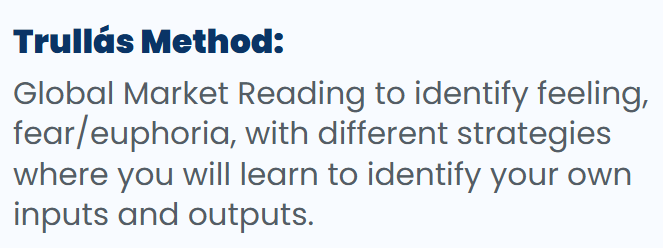
Here is a screen shot from David Trullas's Webpage Based on the official World Cup Trading Championships® (WCTC) standings  the world's premier independently verified, real-money trading competition, running since 1983  the best-performing day trader over the past 9 months (Dec 2025 → Sep 2026) is David Trullás Vila, a 51-year-old trader from Andorra (born Manresa, Spain, 1974). HIs verified results over exactly your 9-month windowHe competes in the WCTC's dedicated Quarterly Futures Day Trading Championship divisions, and his streak is unprecedented:
The Q2 2026 figure of +2,222.6% is the absolute record in the history of the day-trading specialty. Counting back further, he also won Q3 2025 (+800.6%)  that makes four consecutive quarterly world day-trading titles, earning him recognition as a 4-time World Day Trading Champion with the specialty's all-time record. He trades via his proprietary "Método Trullás," "Método HLIT," and "Método Cyborg Techs" methodologies (registered with the U.S. Copyright Office), and he's the founder of the Live in Trading school. So we can see that David has already learned to trade
without emotions of fear, greed, etc. getting in the way of making
successful decisions and is using this as a key benchmark for
successfull day trading. |
View In-Depth Report titled: Emotional Regulation as the Decisive Factor in Successful Stock Market Day Trading